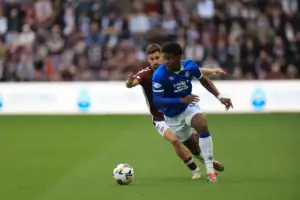
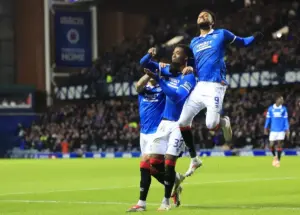
Rangers exited the Scottish Cup on penalties to Celtic on Sunday despite a dominant performance throughout 120 minutes of football.
But, as ever with the Old Firm fixture, the biggest headlines are not about the football.
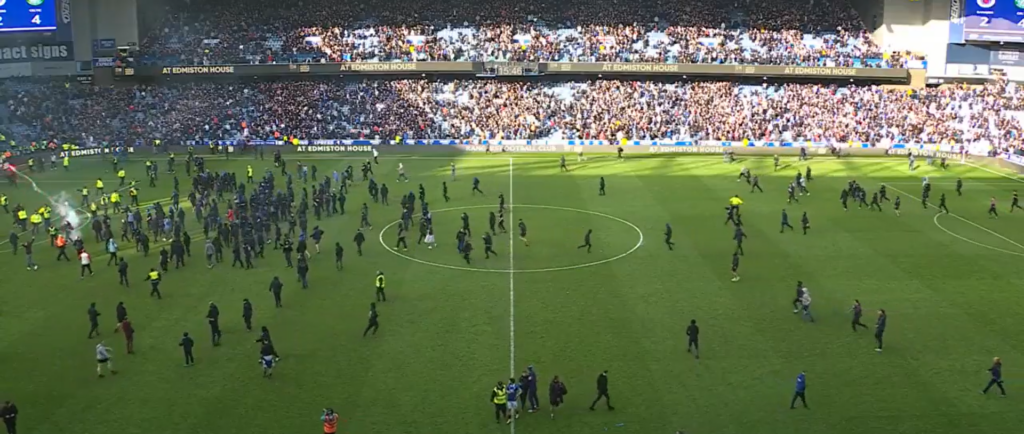
This time, it was the disorder that erupted soon after Tomas Cvancara’s decisive penalty to give the hosts the win and progression to the Scottish Cup semi-finals, where they will play St. Mirren.
Much was made of the return of the almost 8,000 Celtic allocation in the Broomloan Stand with many hoping for a future return of the ‘traditional’ allocations for away supporters in this fixture.
Post-Match Chaos at Ibrox
But surprise, surprise, the actions of the loud minority will ruin the chances of the majority on both sides to get regular tickets for away fixtures.
Following Celtic’s final penalty to ensure a 4-2 win on spot kicks, the usual suspects within their support rushed onto the field.
This will be disguised as celebratory, but in reality, they were on there to goad Rangers supporters, to revel in their disappointment and inflame tensions.
Which, unsurprisingly, it did as Rangers supporters rushed onto the park from the Copeland Road end, with Celtic fans quickly retreating into the stand as a wall of police formed along the 18-yard line.
There have been multiple videos circulating online showing supporters engaged in fights, with several people requiring treatment for injuries in the aftermath.
The governing bodies, both within football and externally, have just received exactly what they were after.
Those hoping that the larger away allocations could become a regular feature of the fixture again will almost certainly be disappointed.
Sunday’s scenes have only strengthened the argument that the current model is unworkable, and it would be no surprise to see a swift return to reduced allocations, or even a complete removal of away supporters at Old Firm fixtures once again.
The Lead Up
The disorder was not limited to the closing stages of the match.
Before kick-off, there were reports of groups of Celtic supporters forcing their way through turnstiles to gain entry to the stadium without tickets.
Videos on social media showed how this unfolded.
Rangers are also understood to be aware of offensive graffiti within the away end mocking the 1971 Ibrox disaster, an act that has been widely condemned but sadly becoming ever more common in recent years.
There were also flashpoints during the game itself.
In the aftermath, Rangers confirmed there had also been damage to seats and toilet areas within the section allocated to the visiting support.
Taken together, the incidents make it increasingly difficult to see how the previous larger allocations can continue.
The Old Firm fixture has always required heavy policing and tight safety planning, but Sunday’s scenes will only reinforce the view among authorities that limiting interaction between the two sets of supporters is the simplest solution.
Booze Ban

There may also be wider consequences beyond ticket allocations.
Scottish football has recently been exploring pilot schemes that would end the 46-year ban on alcohol being sold and consumed within stadiums.
Those discussions have already been cautious, and the disorder surrounding this match is unlikely to strengthen the argument of those pushing for change.
With images of pitch incursions, fighting and stadium damage circulating widely, it is difficult to see policymakers becoming more comfortable with loosening restrictions at matches any time soon.
The debate over supporter behaviour will therefore stretch far beyond one cup tie.
Rangers are still due to travel to Celtic Park after the Premiership split in what could be a decisive fixture in the title race.
However, the events surrounding this latest meeting are likely to ensure supporter allocations, and the broader question of matchday safety are once again front and centre of discussions between the clubs, the police and authorities in the coming weeks.
For many supporters, who simply want to follow their team away from home, the consequences of Sunday’s disorder may be felt for years to come.


Comments.
Loading comments…