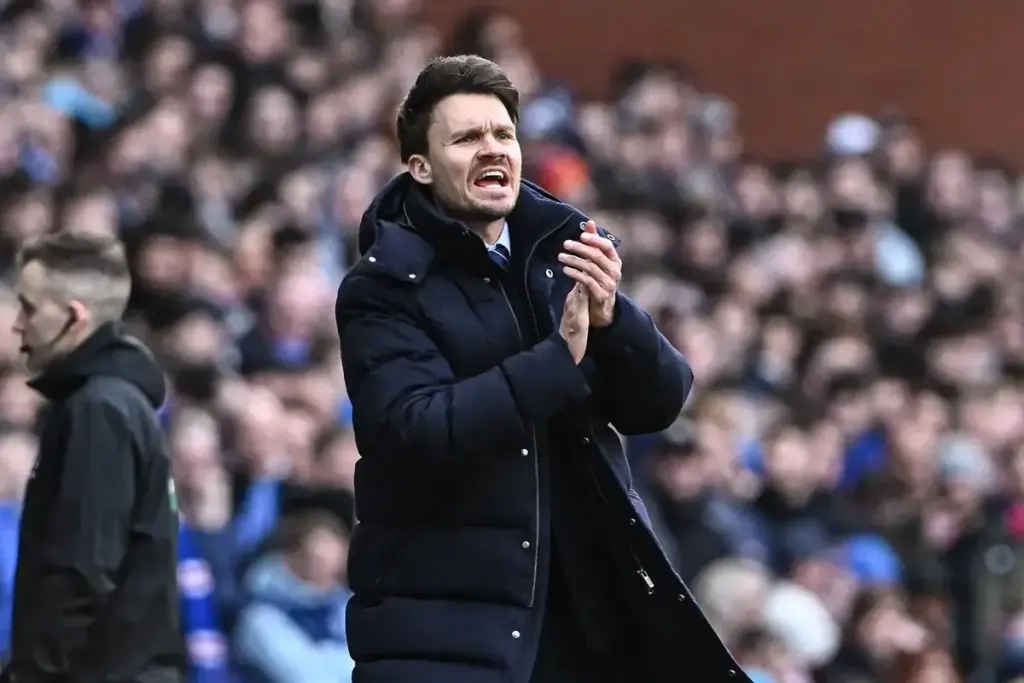
Danny Rohl’s Rangers side came under criticism after the recent derby draw with Celtic, where the team were accused of being too direct and relying on long balls to the two centre forwards.
Rangers struggled to break down Celtic’s deep defensive setup and eventually went out on penalties after a 0-0 draw.
But the match also showed the wider context Rohl is working in. Celtic arrived at Ibrox set up very defensively, almost like a bottom-six team hoping to escape with a draw.
Rangers have struggled against this kind of low block for years.
More importantly, Rohl is still working with a squad that was not built in his vision – or even from one viewpoint.
Even after four signings in January, Rangers remain a group assembled under several different managers and recruitment teams. The result is a squad without a clear long-term identity.
Because of that, Rohl has had to adapt his approach.
His current Rangers team often looks more direct than the style he previously used at Sheffield Wednesday. Looking back at how his teams played there offers clues about how Rangers could evolve once he is able to reshape the squad.
Coaches’ Voice looked into Rohl’s second season at Sheffield Wednesday and his tactical setup prior to his arrival in Scotland.
Five months down the line we can now see the similarities and differences with his Rangers team – and compare and contrast the setup so far.
The tactical setup
Full backs are key to Rohl’s system
One of the clearest features of Rohl’s teams is how early his full-backs push forward.
At Sheffield Wednesday he used several formations, sometimes a back four and sometimes a back five.
But when building from the back four, his centre-backs would split wide while the full-backs moved high up the pitch early in possession.
This is something Rangers supporters will already recognise.
Either John Souttar or Nasser Djiga often split wide from Emmanuel Fernandez within build-ups, while Tuur Rommens regularly pushes very high on the left with Dujon Sterling a bit further back on the right.
The difference is that Rohl’s system at Wednesday depended on calm build-up play.
At Rangers that has not always been possible.
Goalkeeper Jack Butland has often chosen to go long rather than play through pressure, even when the shape suggests Rangers are trying to build from the back.
At Wednesday, Rohl also relied on a double pivot in midfield.
Two deeper midfielders helped circulate possession and give defenders passing options. One of them would often drop deeper to help move the ball across the pitch.
That movement allowed a centre-back to step forward with the ball and connect with attacking players or advancing full-backs.
When opponents pressed with extra attackers, one midfielder could move wider to create space and pull defenders out of position.
This often freed the full-back on that side to move forward – similar to how Ryan Jack operated with James Tavernier last time Rangers won the league title.
These small rotations helped Wednesday progress the ball much more smoothly than Rangers manage at the moment with only two central midfielders.
Narrow attacks and overlapping width
Another important feature of Rohl’s attacking style is the way his teams combine through the middle before using wide areas.
In Sheffield the attackers and midfielders often moved close together in central areas and quick short passes allowed them to break through defensive lines.
This narrow shape also meant there was space out wide for full-backs or wing-backs to attack.
Because the full-backs had already moved forward during build-up, they were well placed to overlap and deliver crosses into the box – something we have already seen with January recruit Rommens.
The result was a very fluid attacking shape with lots of movement. In Rohl’s second season at Wednesday the team produced more crosses, more shots and far more attacking pressure than the season before.
For Rangers, that type of attacking structure could eventually suit players like Andreas Skov Olsen and others operating in wide areas. But it requires midfielders comfortable linking play and defenders confident on the ball.
Flexible defensive structure
Without the ball, Rohl’s teams have also shown flexibility.
When defending with a back four, Wednesday often used a mid-block rather than constantly pressing high. The front two players worked together to block central passes and force opponents wide.
From there, the team could adjust depending on the opponent. Sometimes they defended in a 4-4-2 shape, while in other situations it became a 4-4-1-1 or 4-2-3-1.
The goal was to remain compact while still being able to press when the ball moved into wide areas.
Those pressing triggers often appeared when opponents passed backwards, allowing the team to push higher up the pitch and regain territory.
We have seen Rangers come and go with a press in recent weeks, with some players visibly unsure of when to go, and when not to go.
Rangers have had their most successful spells in recent years with high fitness levels and with that, high intensity pressing. This is something Rohl has shown before that he wants, but has not fully implemented it yet.
Without a full pre-season to get the squad up to his own standards of fitness, we may be seeing the limitations of a mid-season managerial change here.
What the Celtic match showed
The recent league Old Firm derby highlighted both the positives and the weaknesses of Rangers under Rohl in a competitive game, in comparison to the stuffy Hoops side they faced in the cup a week later.
In the first half the team’s direct approach worked well.
Rangers attacked quickly, pushed numbers forward and created dangerous situations around the Celtic penalty area – showcased by Yousef Chermiti’s stunning opening goal.
But the same approach became a problem later in the game.
When Celtic gained control of midfield with some half-time substitutes, Rangers struggled to keep possession.
Long balls that had previously helped them attack quickly began to give the ball straight back to their opponents, with second-striker Ryan Naderi sacrificed for an extra midfielder in the shape of Mohamed Diomande.
As fatigue set in, Rangers looked caught between pressing high and dropping deeper.
The lack of midfield control and panic throughout the team allowed Celtic to grow into the game.
In many ways the match showed a team still in transition, with some strong signs but clear weaknesses left over from previous regimes.
What could change after the summer
If Rohl is backed in the summer transfer window, as he was in January, Rangers could evolve into a much more balanced side.
The foundations are already visible. The wide defenders push forward early, attackers make aggressive runs and the team can create overloads quickly in the final third.
But Rohl’s previous work suggests he prefers a more controlled version of this approach.
With defenders comfortable on the ball, midfielders capable of linking play and a goalkeeper confident in possession, Rangers could begin to dominate games more through structure and movement rather than relying so heavily on direct attacks.
For now, Rohl is working with what he has.
But once he has the players suited to his ideas, Rangers supporters may see a much clearer version of the style he built earlier in his coaching career.
The only question is. Will he be afforded the time, not just from those in the boardroom, but from those in the stands?






Comments.
Loading comments…