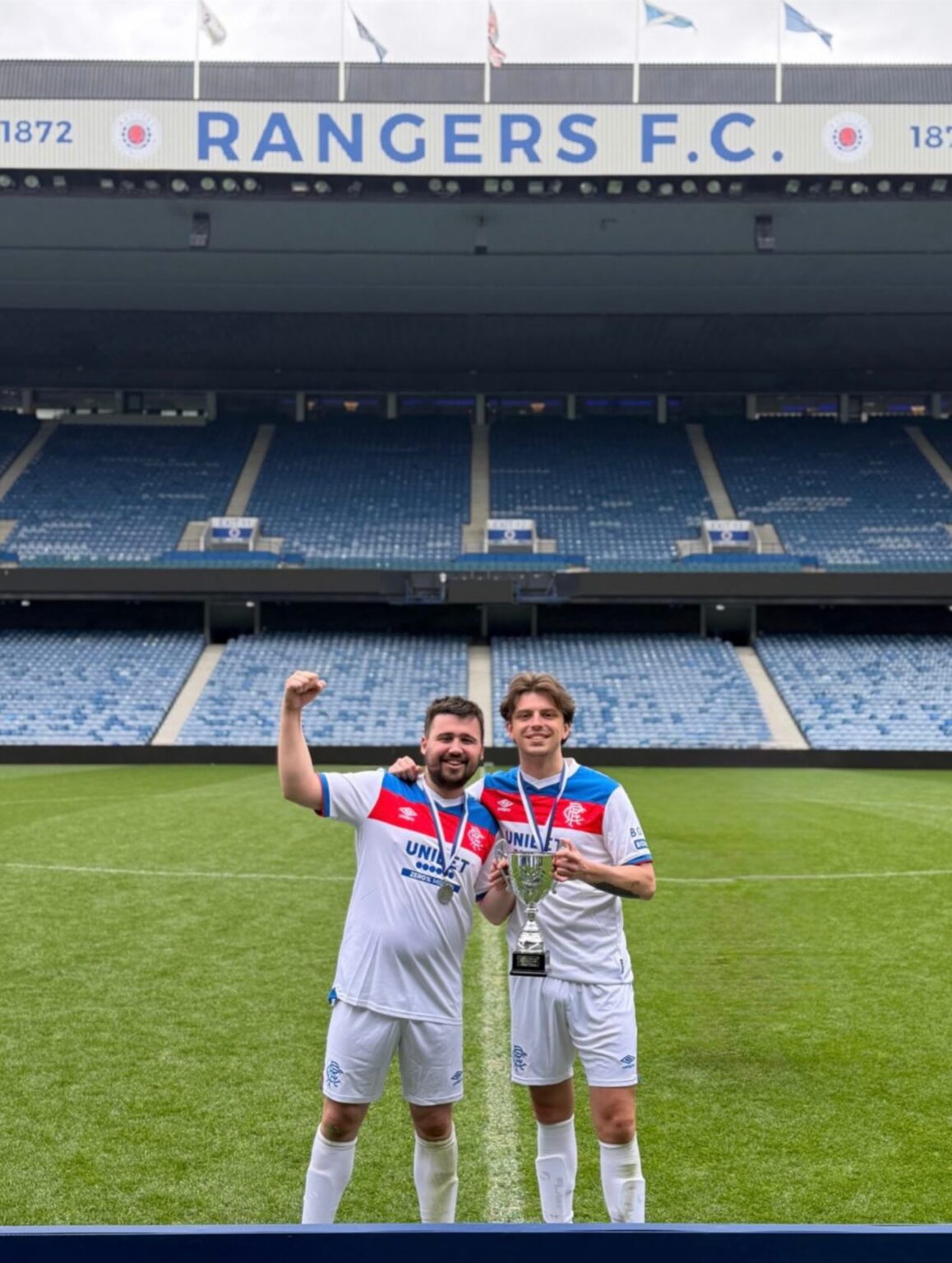
- Our writer Jack Cranmer played for competition-winning side in William Hill Ibrox Pitch Day match against employee team.
- Experience full Ibrox behind-the-scenes journey before and during chaotic high-scoring 9–7 game.
- Read about his contributions to the game, tactical involvement, and played through fatigue in surreal dream appearance at Ibrox.
I was part of a competition-winning side for William Hill’s Sponsors’ Ibrox Pitch Day, taking on a team made up of their own employees in a match that mixed light-hearted occasion with a surprising edge of competitiveness.
Set against the backdrop of Ibrox, it wasn’t just an exhibition game, it quickly became something more intense, with pride on both sides and the kind of informal pressure that comes when no one wants to be on the losing team at a stadium like that.
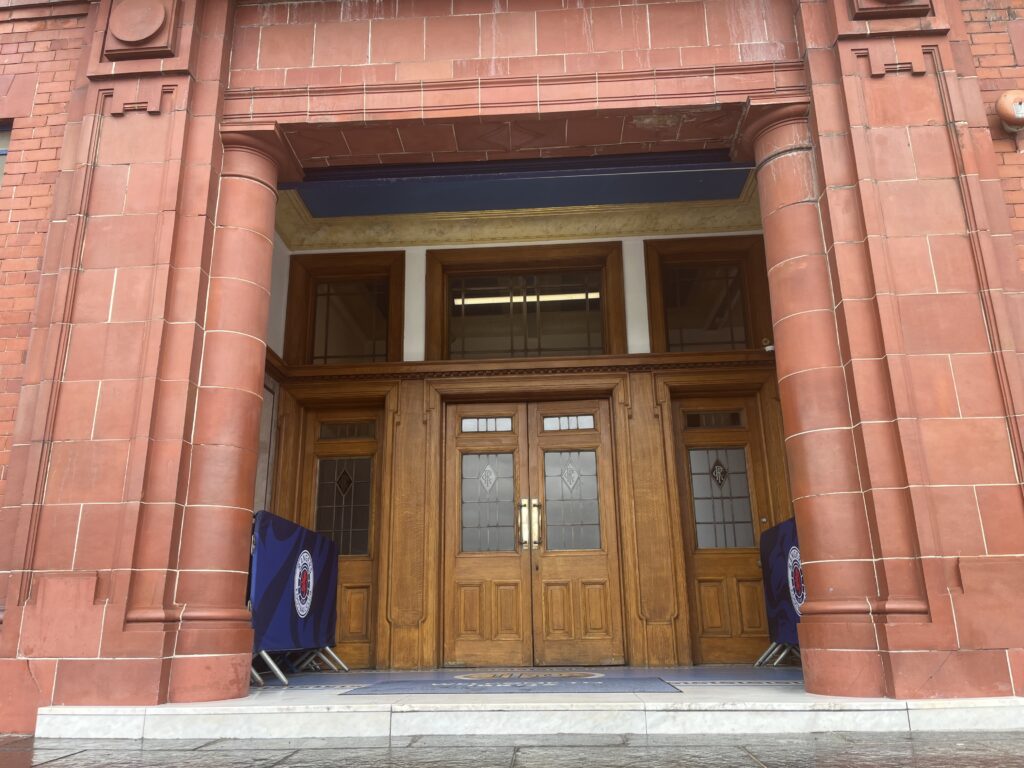
I arrived at the glorious Archibald Leitch facade that is Ibrox stadium just before 1pm, the red sandstone still imposing even on a quiet afternoon, the kind of structure that feels less like a stadium entrance and more like a gate into something older, heavier, and far more meaningful than football alone. Home.
Inside, I made my way through reception witnessing the famous marble stairway that leads to the manager’s office and the trophy room adorned with silverware and banners from successful eras past.
The noise of the outside world dropping away with every step through the main doors until it felt like the building itself had closed in around me.
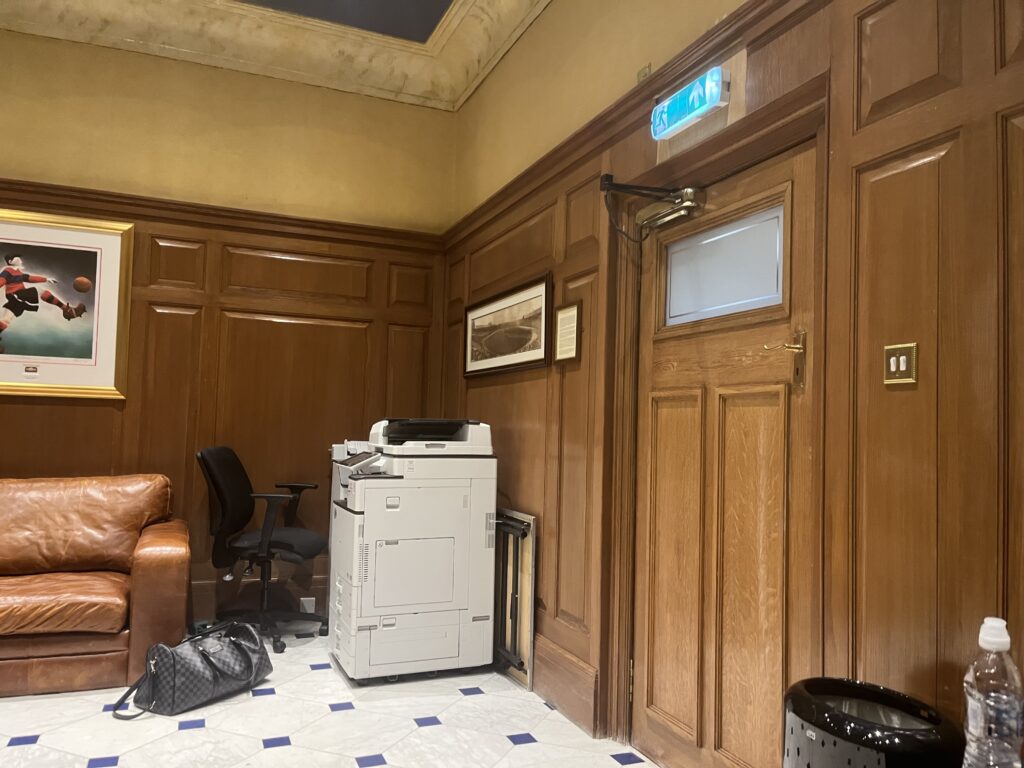
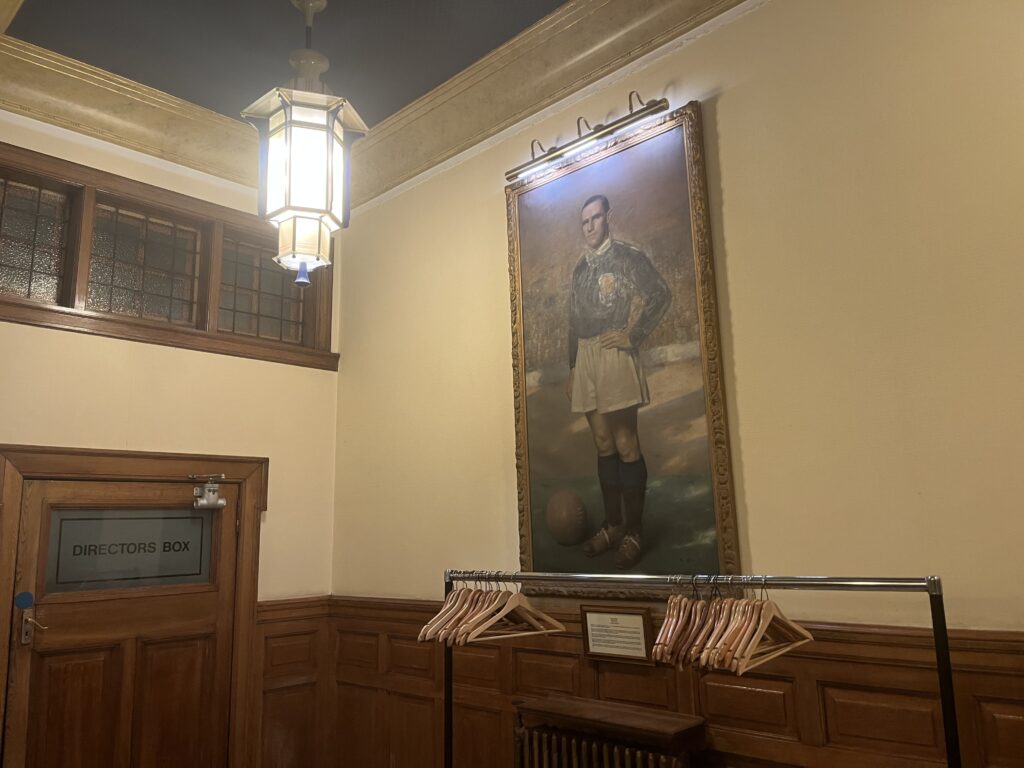
Off to the left sat a waiting room lined with Rangers artwork, each piece telling its own fragment of history, but one stopped me.
A rare, one-off poster of the old Ibrox grandstand before the first disaster in 1902, the only surviving image from that time. It hung there almost silently, a reminder that this place carries memory as much as matchdays.
From there, we were taken into the away dressing room. The high pegs still stand out immediately, absurdly tall by modern standards, originally designed to intimidate visiting sides in an era when scouting didn’t exist and size was as much psychological as physical.
You could almost imagine opponents walking in and wondering what sort of giant team they were about to face.
The kit was laid out waiting. White away shirt with blue and red trim, perfectly folded in it’s plastic, branded casing, almost ceremonial in its presentation. It felt less like changing into a strip and more like stepping into a role already written long before you arrived.
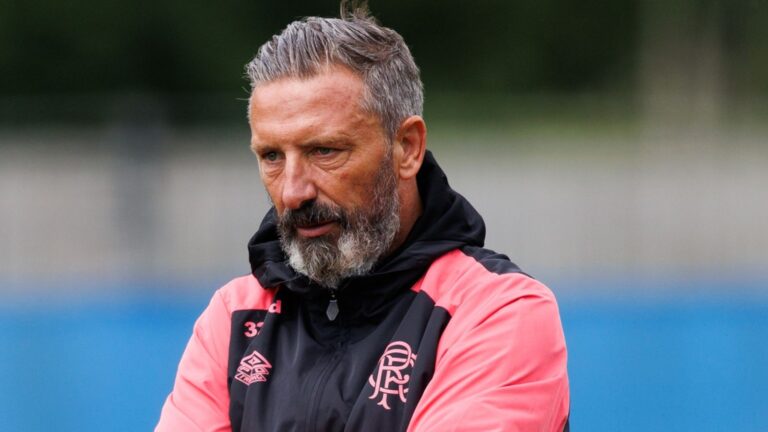
Then Lee McCulloch walked in.
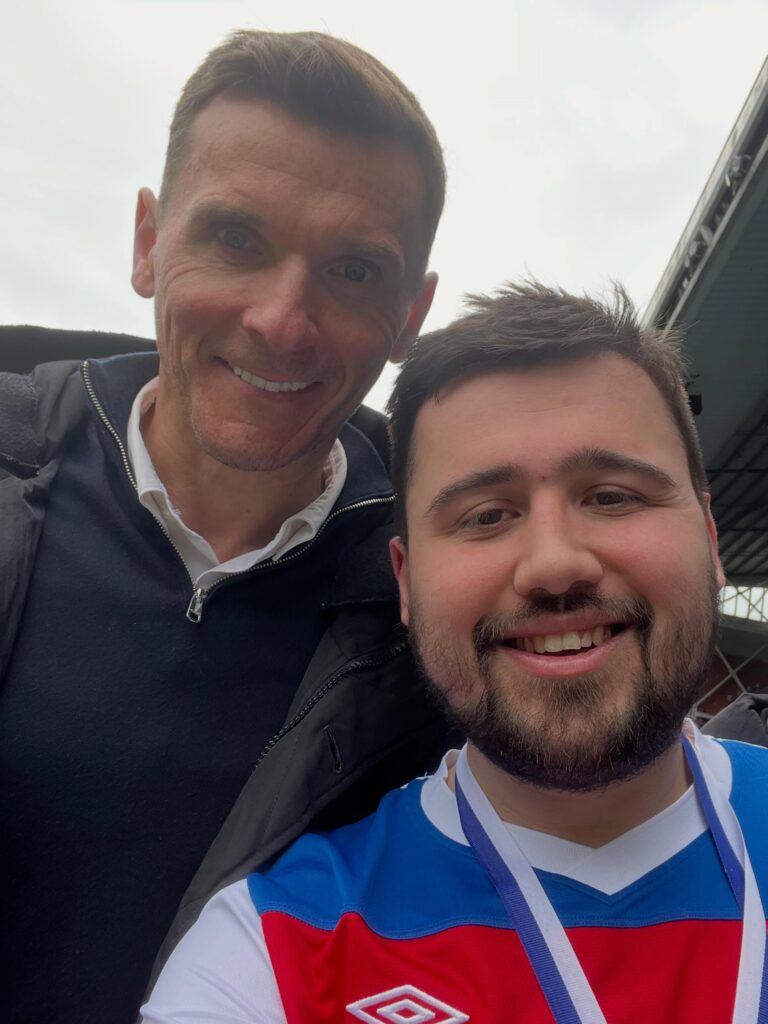
Lee McCulloch – The boss
Our gaffer. A man I had watched lift trophies under Walter Smith, a captain who had dragged Rangers through the lower-league years with authority, presence, and that unmistakable hard-edged calm.
He didn’t need a speech. Just a smile, a bit of trademark banter, and a firm handshake for every player in the room. It settled everything instantly.
When it was time, we stepped out towards the tunnel. The walk alone felt like a shift in reality, like something from childhood imagination.
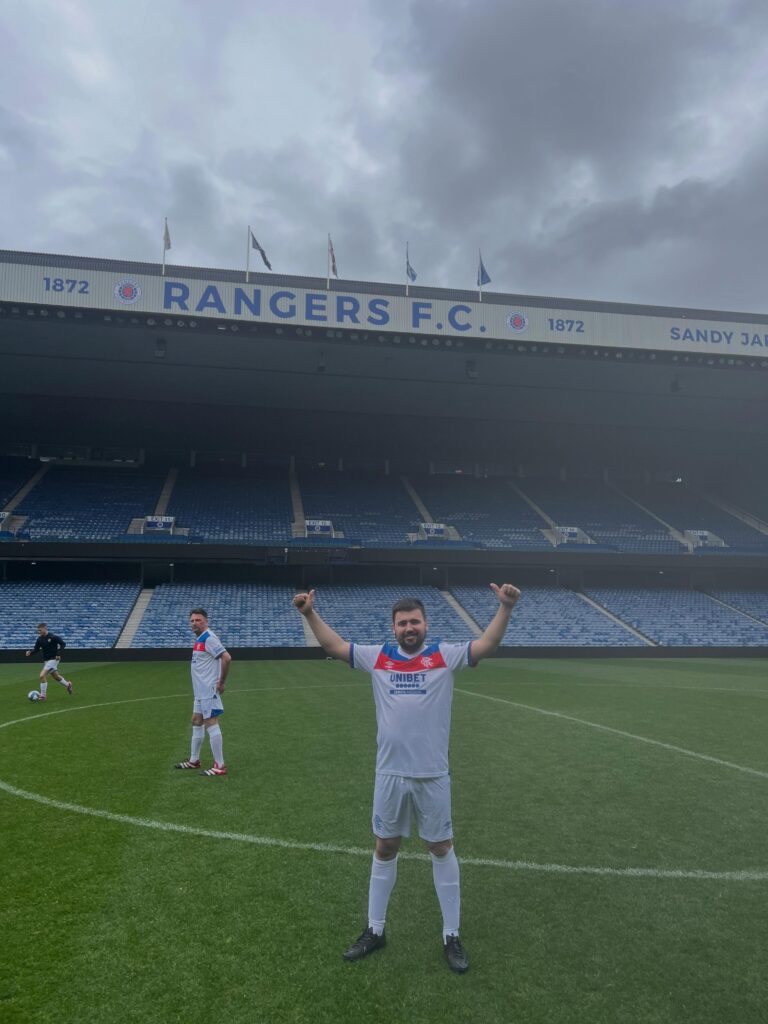
And then, out into the light, where Ibrox opened up in full view, the words “Ibrox Stadium” stretched across the skyline, flags snapping in the wind, the stands towering in every direction.
It was everything you imagine, and still more than that, even without 50,000 adoring supporters.
As I looked across the pitch, I felt something unexpected, not just excitement, but a strange sense of accountability. Guilt, almost, for every time I had ever shouted from a distance, demanding perfect passes, inch-perfect crosses, goals into postage-stamp corners as if it were simple.
Now I was here, standing on it properly, and the question shifted from judgement to reality. Scoring goals in the warmup was easy under no pressure, but the question was. Could I do it myself?
Kick-off was approaching. And I was about to find out.
Pre-match
Back in the dressing room, the atmosphere shifted into something more controlled, more intimate. There was no roar from the stands, no crowd noise spilling down from the tiers. Just the voices of friends and family dotted around the stadium, close enough to recognise, quiet enough to make every instruction feel sharper.
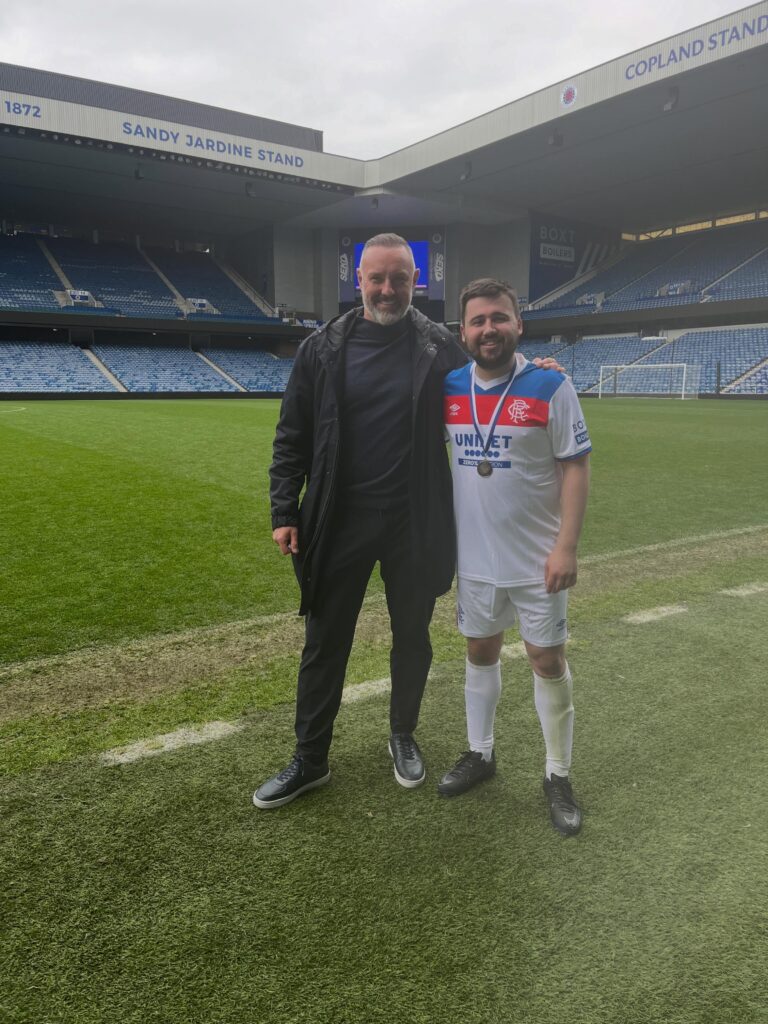
Kris Boyd was on the opposing touchline, still unmistakable in tone and presence, every joke and shout landing with that familiar Sky Sports edge you’d normally associate with him trading lines with Chris Sutton.
Even in a setting like this, he carried that same energy, competitive but conversational, as if the broadcast had been switched off but the personality hadn’t.
Inside our dressing room there were 15 players for 11 positions, and that simple fact starts to define everything. You do the quick calculations, you watch body language, you wait for your name, and you try not to think too far ahead.
When the opportunity came, I didn’t hesitate.
Left-back.
Not my natural position at all, I’m very right-footed, and in any normal setting or Sunday league clash I’d never have considered it. But this wasn’t about comfort or preference. It was about being part of it, about stepping onto that pitch at Ibrox and not letting the chance slip past for as many moments on that turf as possible.
So, I took it immediately.
There was no debate in my head. No tactical overthinking. Just a clear instinct that if this was the moment, then I was going to be on the pitch for it, wherever that meant I had to play.
Because once you’re in that building, once you’re changed and ready and standing there knowing you’re about to walk out, position becomes secondary to presence. You don’t ask for the perfect role. You take the one that gets you onto the grass.
First half fatigue
The whistle goes, sharp and immediate, and the game begins.
There’s no build-up in your head when it actually happens. No time to reflect on where you are or what it means. It’s just action. Movement. Shape. The linesman’s flags are up, the referee is already in stride, and everything narrows down to the first touch.
I settle quickly.
Even though I’ve been named at left-back, my instincts from my youth days at right-back slowly kick back in, and it shows in how I approach the early moments.
Nothing fancy, nothing forced. Just positioning, scanning, and making sure the line stays intact.
A through ball comes into my channel early. I read it a fraction before it arrives, step across, take control, and do the simplest thing possible, I roll it back to the keeper.
Safety first. No hesitation. No risk. From there, it becomes rhythm.
Clearances when needed. Headers out for throws when the situation demands it. No glamour in it, no highlight-reel moments, but a steady presence in a game that doesn’t require anything more complicated.
That’s the thing about night like this, or afternoons like this, in this case, you realise quickly that influence doesn’t always look like flair. Sometimes it’s just about being reliable, about doing the unremarkable things properly so nothing becomes a problem.
I find my feet in it. Not trying to impress, just trying to be solid, to stay switched on, to keep my side of the pitch under control.
We start to take control of the game.
Two goals up, and both come in a similar fashion, high, direct balls into advanced areas that our striker reads better than anyone else.
A former junior player, now in his middle years, he attacks them with timing and aggression, finishing twice from midfield deliveries that drop just right for him. It feels efficient rather than flashy, but it puts us exactly where we want to be, in control at Ibrox.
The mistake
For a spell, it feels comfortable.
But football has a way of punishing comfort that isn’t fully earned.
Our midfield, buoyed by the scoreline and the occasion, start committing further and further forward.
Everyone wants their moment at Ibrox, everyone wants a story to take away from it. The problem is that the shape starts to stretch.
We get caught.
On one transition, I see it developing too late. The left centre-back shifts across to cover space, and suddenly I’m isolated at the back post with two runners. For a split second, I hesitate. Do I step out? Do I hold the winger? The decision doesn’t come cleanly enough.
By the time I move, it’s already wrong.
The ball arrives into the danger area. I stick a leg out, miss it. I then try to take the man out on the edge of the area in a last ditch attempt to stop the certain goal. That attempt misses too.
And just like that, they’re back in it.
A home player in the iconic blue of Rangers is first to react. It’s his moment now. He celebrates like he’s lived it a hundred times in his head already, and I can’t blame him.
I just drop my head for a second.
Twenty minutes in, and reality catches up with me. I haven’t played 11-a-side properly in ten years, and it starts to show in the simplest way, fatigue. Not dramatic, not cramping, just that heavy feeling in the legs where every recovery run costs more than it should.
I look over to McCulloch and make the gesture. Sub me off for a breather.
It’s not defeat. It’s necessity. And with rolling subs, it’s understood, I’ll be back on.
Dugout discussions
While I’m off the pitch, the game shifts again.
We go further behind, 4–2 now, and from the touchline you can feel the momentum slip entirely. It’s no longer about control or rhythm. It’s stretched, chaotic, end-to-end, the sort of game where structure disappears and legs start to dictate outcomes, none of us are pros, and the tactical stability only lasted so long.
I’m standing just inside the technical area, watching it unfold, and instinct takes over. I start pointing out what I can see, the gaps between midfield and defence, the space we’re leaving in transition, the lack of cover when we push forward.
What happens next still feels slightly unreal.
Lee McCulloch turns to me.
Not dismissively. Not indulgently. Properly listening.
And then, to my surprise, he agrees.
There’s a brief moment where it all shifts in tone. I’m not just a player on the sideline anymore; I’m part of the conversation. Sitting in the dugout at Ibrox, discussing shape and adjustments with a Rangers legend and former Scottish Premiership manager, feels completely detached from anything I’ve experienced before.
It’s surreal in the most understated way, no fuss, no theatrics, just football talk in one of the most iconic settings in the game.
We make a couple of simple calls. Nothing dramatic. Just tightening distances, being more disciplined in transition, making sure the full-back doesn’t get isolated again in the same way.
Then McCulloch looks across and asks the question.
Was I playing left back earlier? Yes, I reply. He asks if I’m fit to go back on.
There’s only one answer.
Back on the pitch
I get up, pull myself back into position, and head once more towards the left-hand side of defence for the final five minutes of the half.
Whatever happens next, it’s back on me.
We get ourselves back into it.
Somehow, against the flow of the game and the chaos of the second half of the first period, we drag it level at 4–4 by the break. There’s no real logic to it at that point, just momentum swings, moments of quality, well comparable quality given the standard, and a game that has completely lost its structure.
Back in the dressing room
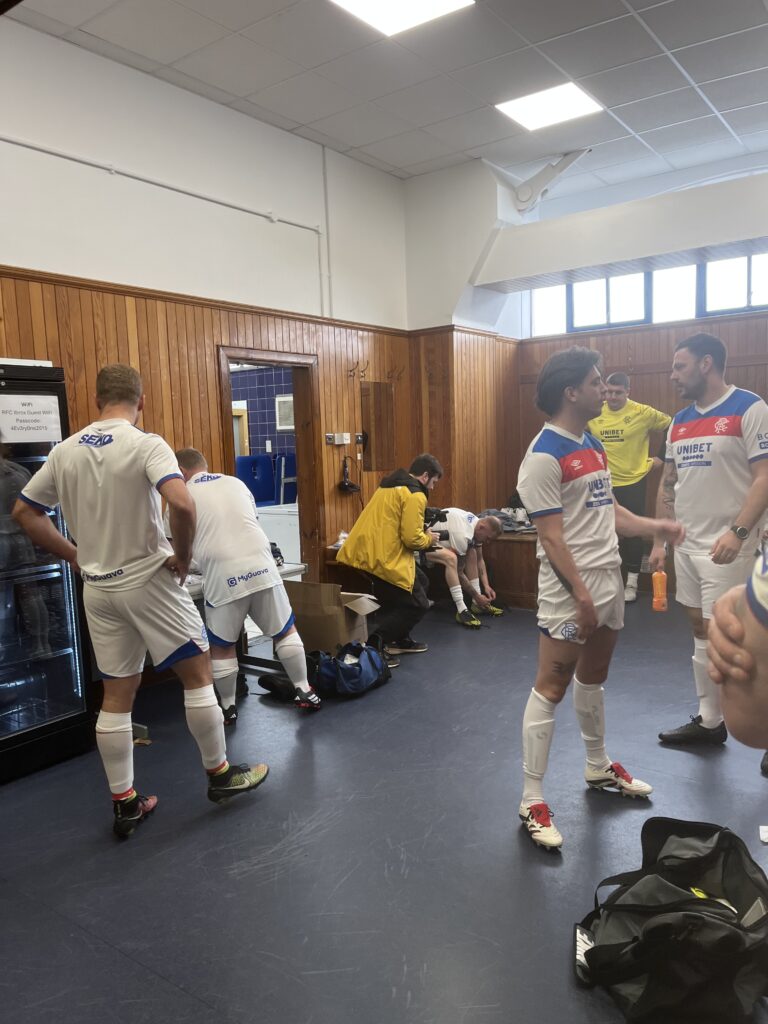
At half-time, the dressing room is exactly what you’d expect: a mix of laughter, exhaustion, and disbelief. Jig is back in familiar mode almost immediately, cracking jokes, lightening the mood, bringing the temperature down before it runs away with itself.
Then he switches. He asks the question properly. What’s actually wrong?
And it’s obvious when we say it out loud. The shape is stretched. The distances are wrong. We’re too eager to get forward, leaving ourselves exposed in transition. Everyone agrees almost instantly, it’s not complicated, just basic discipline slipping in the chaos of the occasion.
He tells us to fix it. We all nod.
Then he drops something none of us had clocked.
During all of the madness, all the flow, all the back-and-forth of a ridiculous first half, Kris Boyd’s side had quietly done something none of us had fully registered, they’d effectively slipped a 12th man onto the pitch.
A little bit of mischief, a bit of gamesmanship, the sort of thing that goes unnoticed when you’re caught up in the rhythm of it all.
If that’s the game being played, then fine.
We look at each other, and almost instinctively, the response comes.
If that’s how it’s going to be… we do the same.
The final whistle
In the end the final whistle goes at 9–7.
It feels less like a controlled finish and more like the natural end point of something that was always going to burn itself out.
By the closing stages, legs are gone across the pitch. not just mine, everyone’s. It’s not the tempo of elite football, but it is played on a pitch that demands more than any of us are physically used to.
This is Ibrox, proper dimensions, proper weight to every sprint, and by the end it shows.
There’s no structure left, just moments.
Kris Boyd’s touchline antics
They get a questionable penalty along the way, one of those decisions that feels like it carries a bit of familiarity to it, the linesman involved almost too comfortable in the moment, too aware of the occasion and the personalities involved.
Boyd’s touchline presence never really fades from the game, and neither does the sense that the margins are being influenced as much by chaos as football.
He even slipped one of his 12 men off before calling out our advantage to the linesman – that cheeky chappy knows all the tricks of the trade.
Second half heroics
Still, we score enough to win it.
Our forward takes centre stage with five goals, the sort of performance that bends the game around him.
I contribute one assist, simple in execution, but exactly the kind of moment I’ve always been defined by. I pick the ball up on the left side, carry it maybe ten yards into space, nothing elaborate, no dribbling or flair. I’ve never had that in my game.
But I’ve always had the pass.
It’s the one thing I trust completely, timing, weight, direction. Nothing more complicated than that. I slide it over the top, perfectly judged, and the forward does the rest, rounding the keeper and finishing. It’s not an “Ibrox goal” in the romantic sense, but it’s part of it. That’s enough.
My one chance
Earlier in the game, I even have my own chance. A strange sequence where I end up carrying the ball from halfway, driving inside without really knowing how I’ve got there. A pass breaks loose off a defender, space opens between centre-back and full-back, and suddenly I’m in.
First touch is good. It sets me for a half-volley.
Everything slows. Even the keeper feels closer than he should be, closing the angle fast. For a second I think about the chip. Then about rounding him. But instinct takes over and I go for power instead.
It’s clean enough… but straight at him.
He blocks it, and it ricochets away.
In that moment, I don’t realise it, but that was it. That was the chance.
After that, it becomes running on fumes. In the final minute I’m chasing a lost cause down the left, racing their keeper to a loose ball that was never mine to win. He gets there first, clears it, and that’s effectively it.
The whistle follows soon after.
I drop to the grass as everything catches up at once.
Fatigue, emotion, disbelief, satisfaction all mixing together in the same moment. McCulloch is there almost instantly, back to jokes without even thinking, teasing me about positioning as if he hadn’t ended his own career popping up with 20 goals from centre-back as we journeyed round the lower leagues.
It’s over.
The end of the dream
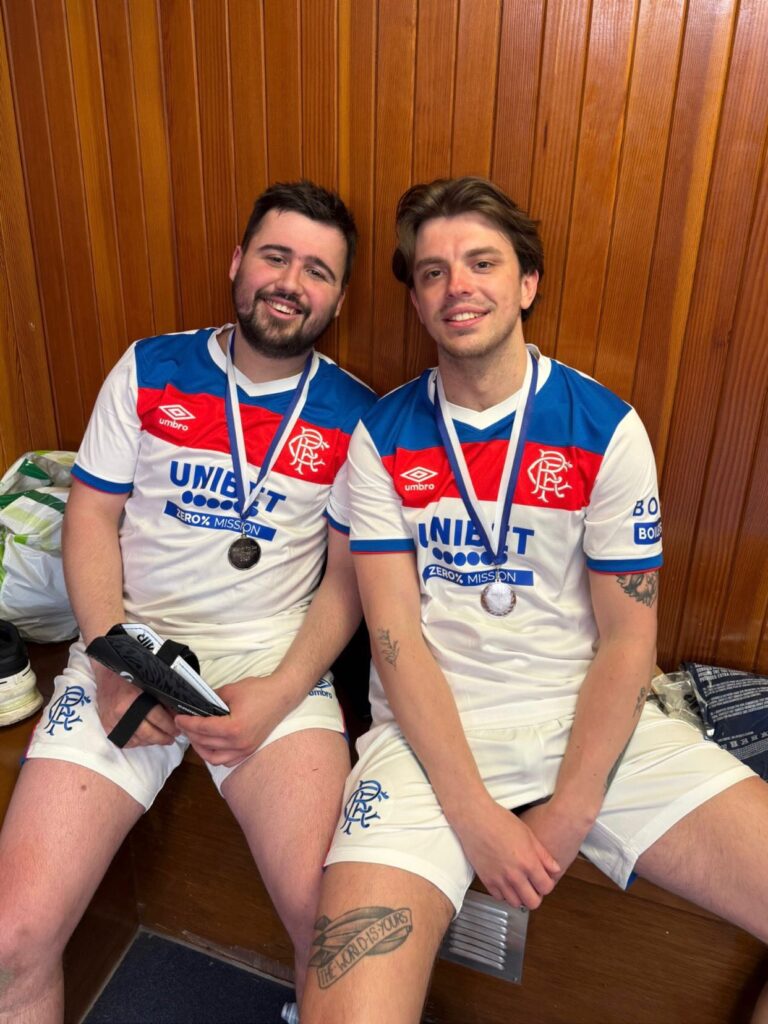
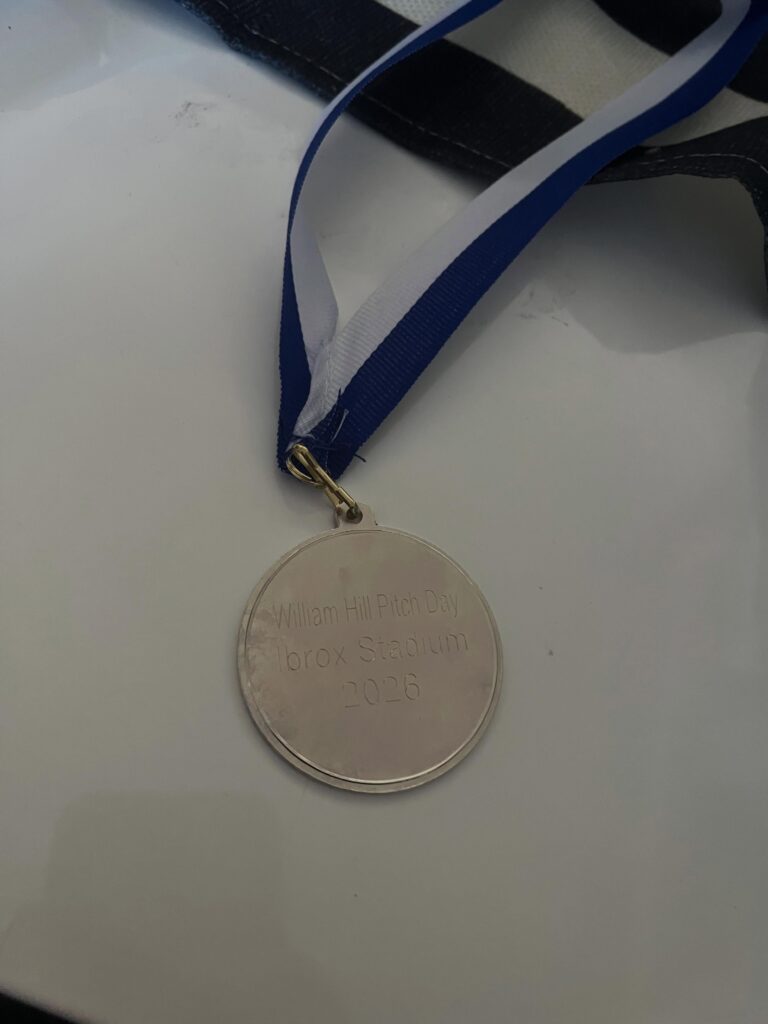
Medals, photos, a cup lifted at the end, the usual final act. Then a shower, something to eat, conversations already winding down.
And then I walk out of Ibrox.
Not as a fan this time, but as someone who has actually played there.
Proud. Exhausted. Slightly frustrated about that one chance.
But more than anything, aware that whatever else happens in football or life, this one doesn’t get repeated.
A dream completed, even if not quite in the way I ever imagined it.

Comments.
Loading comments…