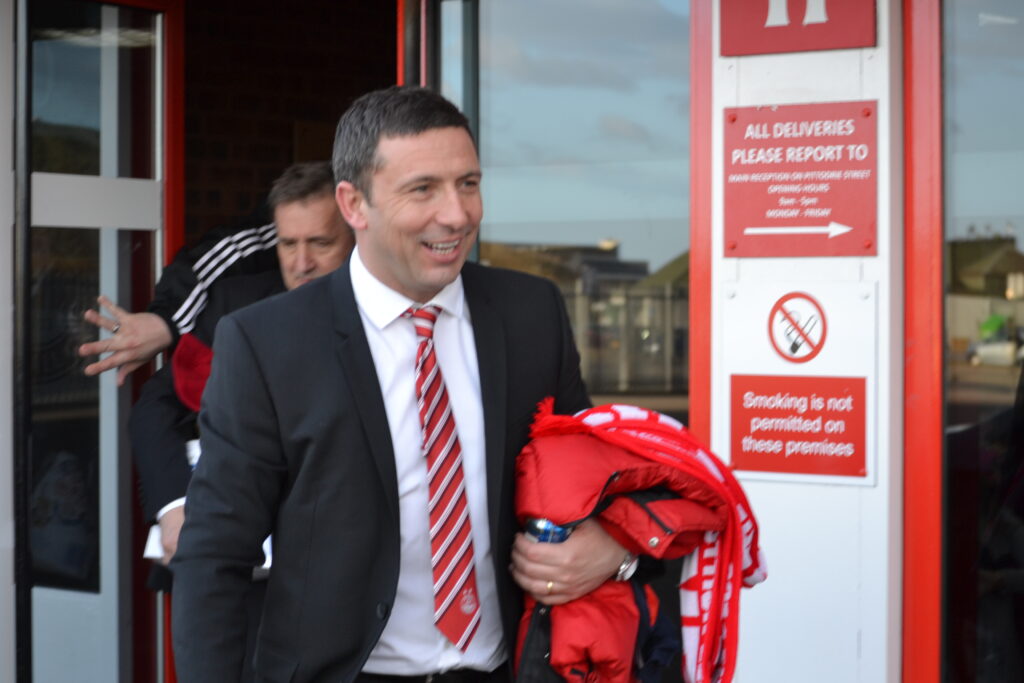
Derek McInnes has not been given the luxury of a soft launch. Rangers have made that clear by moving with unusual speed, stacking the early summer with signings, senior exits, staff change and a public demand for standards before the first serious ball of the new season is kicked.
That is why the first phase of this rebuild should not be judged by volume alone. Five arrivals can look impressive on a graphic. They can also create a false sense of control if the squad underneath them has not been shaped into a team quickly enough.
Rangers confirmed McInnes as men’s first-team manager on a three-year contract in June, stressing his experience, his previous spell as a player at Ibrox and the demands attached to the role. The club also confirmed Alan Archibald, Paul Sheerin and Craig Clark as part of his staff. That was the first structural marker. Everything since has been about whether the football department can give him a squad with enough balance to attack August rather than merely survive it.
The headline business has been aggressive. Lawrence Shankland arrived first. Ben Godfrey followed on loan from Atalanta, with an option to make the move permanent. Ivor Pandur was then confirmed on a four-year deal from Hull City, subject to international clearance, before Dan Neil became another significant midfield addition on a three-year contract. Rangers have also been active around the edges of the wider group, with loans, exits and staff movement all forming part of the early reset.
That tells supporters something important. McInnes has not walked into a passive operation. He has walked into one that wants to look decisive.
The speed of the rebuild changes the pressure, not the target
There is an obvious temptation to frame Rangers’ business as proof that McInnes has been backed. In one sense, he has. The recruitment work has moved faster than many recent Ibrox summers, and the club have addressed several zones that demanded attention.
But speed is not the same as completion. The question now is whether the squad has been made more coherent, not simply larger.
Sky Sports noted after McInnes’ appointment that Rangers’ summer rebuild was already being shaped by CEO Jim Gillespie, executive director Fraser Thornton, technical director Dan Purdy and consultant Stig Inge Bjornebye. That matters because this is no longer a manager-only operation. It is a test of whether Rangers’ new structure can connect ownership ambition, recruitment logic and coaching detail without producing muddle.
Recent Read Rangers coverage has already underlined the same theme from different angles. The club’s James Taylor exit brought the boardroom element of the reset into focus, while the Dan Neil arrival sharpened the midfield discussion. This piece is the wider test: can all those moving parts become a team identity quickly enough?
The spine has been rebuilt before the style has been proven
McInnes’ early business has targeted the middle of the pitch in the broadest possible sense: goalkeeper, centre-back, central midfield and striker. That is not accidental. Rangers lacked reliability through the spine last season, and no side wins the Scottish Premiership through wide-player sparkle alone.
The profile of the additions is revealing.
- Ivor Pandur: 25, signed from Hull City on a four-year deal, arriving after a promotion-winning season in England and a World Cup summer with Croatia.
- Ben Godfrey: 28, an England-capped defender with Premier League experience and a loan structure that protects Rangers if the fit is wrong.
- Dan Neil: 24, a former Sunderland captain, available as a free agent and signed to add energy, leadership and midfield range.
- Lawrence Shankland: a proven Scottish Premiership scorer who removes some of the mystery from the centre-forward role.
That is a sensible spread of age, contract type and experience. It also creates immediate selection questions.
Pandur’s arrival inevitably changes the goalkeeper dynamic after the Jack Butland exit conversation gathered pace. Godfrey gives McInnes athletic cover and recovery speed, but he still has to adapt to Scottish football’s more direct rhythms and the amount of defending Rangers do in transition when they lose the ball high. Neil brings personality and passing security, but the balance around him will decide whether he looks like a controller or another runner in a crowded midfield.
Shankland may be the cleanest tactical fit of the lot. He understands the league, carries a natural finishing rhythm and should reduce the need for Rangers to manufacture every chance through perfect build-up. Still, even that signing brings a structural challenge. If McInnes wants wide runners to attack the box, Shankland needs service early. If he wants a more patient possession game, Rangers need enough speed around him to avoid becoming predictable.
The McInnes advantage is clarity, but clarity must survive Ibrox
McInnes’ best teams have rarely looked confused. His Aberdeen side had clear distances between units, recognised game-state moments well and were difficult to knock out of rhythm when the match became physical. His Kilmarnock and Hearts work added further evidence that he can build competitive domestic sides without needing endless time on the training pitch.
That experience is useful at Rangers, but it does not remove the scale of the job. It magnifies it.
At Ibrox, a manager is not praised for being organised if the ball moves too slowly. He is not praised for being pragmatic if Celtic are setting the tempo across the city. He is not praised for a sensible away point if the league table is already narrowing by September. McInnes knows that. His appointment quotes made direct reference to expectation, leadership and the club performing as it should.
The danger for Rangers is assuming that proven Scottish Premiership knowledge automatically solves the Ibrox equation. It does not. It merely gives McInnes a better chance of recognising problems before they become public collapses.
His first major task is to settle on non-negotiables quickly:
- how high Rangers press when the centre-backs are still learning each other;
- which midfielder protects against counter-attacks when Neil steps forward;
- whether Shankland plays as a fixed reference point or drops into link play;
- how aggressively the full-backs advance without leaving Godfrey isolated;
- who leads the dressing room after a summer of leadership churn.
Those are coaching questions, not transfer questions. They will decide whether the recruitment looks joined-up.
The market has bought McInnes attention, not patience
The biggest misconception around an active window is that it buys a manager time. At Rangers, it often does the opposite. Each new arrival becomes another reason supporters expect an immediate change in body language, tempo and results.
That is the awkward truth behind the early optimism. McInnes has more tools, but he also has fewer excuses. A slow start cannot easily be framed as a squad he inherited intact. This already looks like a group being reshaped in his image, even if the sporting structure above him is sharing the decisions.
The financial side matters too. Rangers have used a mix of free transfer, loan, permanent signing and controlled-risk options. That suggests an attempt to avoid one-dimensional spending. It also means the club must extract performance quickly from players at different stages of readiness.
Godfrey needs rhythm. Pandur needs a settled defensive language. Neil needs a defined midfield platform. Shankland needs service patterns that do not ask him to solve every attacking issue alone. None of that happens by announcement.
There is also the European clock. Rangers cannot spend July admiring their own efficiency. The opening competitive assignments will test whether pre-season has produced automatisms or just fitness. McInnes’ reputation for order should help, but even order needs repetition.
The verdict: Rangers have made the right noise, now the football has to follow
This has been a strong opening burst from Rangers. The club have acted with purpose, addressed important areas and given McInnes a clearer foundation than many new Ibrox managers have enjoyed.
Yet the defining question is still ahead of him. Can he turn a fast rebuild into a side that looks connected under pressure?
That means more than beating weaker teams by habit. It means Rangers defending transitions properly, moving the ball with conviction, finding repeatable routes into Shankland, using Neil’s leadership without overloading him, and making sure Godfrey and Pandur are not exposed by a team still learning its own distances.
The early transfer work has changed the mood. That matters. Ibrox needed evidence of urgency after another bruising cycle.
But the only rebuild that counts is the one visible on the pitch. McInnes has the experience to know that Rangers supporters will not remember July for the number of announcements. They will remember August and September for whether those announcements looked like a plan.
For now, the plan has shape. The next stage is harder: making it breathe.
Sources: Rangers official McInnes announcement, Rangers official Dan Neil announcement, Rangers official Ivor Pandur announcement, Rangers official Ben Godfrey announcement, Sky Sports McInnes analysis.



Comments.
Loading comments…