
“`html
Headline: Europa League Deadline Leaves McInnes No Rangers Grace
Content:
Derek McInnes faces no soft landing at Rangers. He returns to Ibrox amid swirling emotions, an active transfer window, and an unforgiving European calendar. The Europa League waits for no one.
While the league campaign is his priority, McInnes knows the first major test of his Rangers rebuild may come before the Premiership fully unfolds.
Rangers enter the Europa League at the third qualifying round. The draw is on July 20, with matches on August 6 and August 13, as detailed by SunSport’s competition explainer. McInnes has limited time to transform principles into a team capable of surviving two-legged ties.
This summer’s success won’t be judged solely by new signings. Speed, fit, and clarity are crucial.
The European route turns planning into pressure
The Europa League offers opportunity but removes comfort. Rangers can’t wait until September to assess their rebuild. They need a functional team by early August.
European qualifying is not mere background noise for Rangers. It involves money, prestige, squad status, and transfer leverage. It’s also a quick way for a new manager to build trust or lose credibility.
The structure is challenging. Rangers start at QR3, with a play-off round if they progress. UEFA’s competition hub has already moved past the second qualifying round draw. McInnes will soon prepare for opponents with competitive minutes under their belts.
Early qualifiers focus on rhythm, set-piece concentration, and away-game control. Avoiding a wild 20-minute spell that turns a manageable tie into a crisis is crucial.
Rangers have learned this lesson in Europe. Their best continental nights relied on discipline: secure distances, reliable midfield coverage, and a front line turning half-chances into leverage. Qualifying requires these details before the team looks polished.
McInnes’ public message now needs a tactical translation
McInnes framed his job in blunt terms during his unveiling. As Sky Sports reported, he spoke of belonging at Rangers, imposing his team on opponents, and making sides suffer at Ibrox.
This language resonates with supporters as a correction. Last season, Rangers seemed caught between systems, recruitment ideas, and game states. McInnes must end this ambiguity.
Identity must manifest in repeatable behaviors:
- How quickly Rangers press after losing the ball.
- Whether the midfield can protect transitions without becoming passive.
- How early the full-backs commit forward against compact blocks.
- Whether the centre-backs can defend space without constant retreat.
- How the striker is supplied when the match becomes tense.
These questions are not abstract. European qualifying will test them brutally. A technically inferior opponent can expose a disjointed side if distances are loose and rest defense is careless.
McInnes’ previous work is relevant here. His best teams were hard to play against because they understood where the game was fought. Rangers need that edge immediately, with more dominance in possession than his previous sides required.
Balancing this is the job. McInnes must make Rangers nastier without narrowing them, more direct without making them crude, and more controlled without reverting to sterile football.
Recruitment has to serve August, not just the season
The transfer window will naturally create noise. Nicolas Raskin’s future, Ross McCrorie’s return, Lawrence Shankland’s role, the wider rebuild under Andrew Cavenagh, and the football department’s influence will all generate headlines.
But the Europa League clock changes the recruitment question. Rangers need players who can be trusted early, not just good players.
A slow-burn signing may still be worthwhile, but McInnes cannot base his first European plan on projects needing six weeks to learn the structure. QR3 demands clarity. It favors players with tactical reliability, physical readiness, and enough personality to handle a tie that can quickly turn hostile.
McCrorie’s return makes sense in this context, despite heavy analysis. A manager entering early European football needs known quantities in the spine. He needs players who absorb instructions quickly and provide competitive security while the team settles.
Shankland’s situation is different but equally important. Rangers’ website noted his focus on Scotland’s World Cup campaign after joining his boyhood club and learning McInnes would be in charge. Once he returns, there’s no long bedding-in period.
The service pattern around him must be designed quickly. If Rangers expect Shankland to lead the line in Europe, the team can’t leave him feeding on second balls and hopeful crosses. He needs early passes into feet, runners beyond him, and enough penalty-box volume to turn his finishing into a weapon.
This will test the wide players, the number ten space, and the speed of Rangers’ circulation. It will also test whether McInnes can build attacking detail quickly without overloading a squad still learning his demands.
The domestic start makes the margin thinner
Europe does not arrive in isolation. Rangers open the league campaign away to Dundee United on July 31, a fixture already framed on this site as an immediate tone-setter for McInnes. Within a week, the same squad will face continental pressure.
This sequence could shape the mood of the entire rebuild. Win early, look organized in Europe, and make the market feel purposeful, and McInnes can quickly gain authority. Stumble through August, and every decision will be scrutinized in a wider debate about whether Rangers moved fast enough after a poor domestic season.
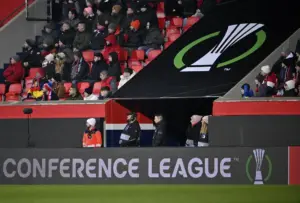
There’s also a financial layer. Europa League league-phase football brings visibility and revenue that can sustain the rebuild. Falling into the Conference League route wouldn’t be fatal in sporting terms, but it would feel different emotionally and commercially for a club measuring itself against serious European nights.
That’s the tension Rangers must manage. The Conference League safety net exists, but the club can’t let it become the mindset. A safety net is not a strategy. Rangers need to act like a Europa League club before securing the right to be one again.
The real verdict will come before the window closes
Supporters often look to the end of the transfer window for judgment. This time, the first verdict may arrive earlier.
By August 13, Rangers will have played a league opener and the first European tie of the McInnes era. By then, supporters will already sense the team’s conditioning, aggression, defensive compactness, and attacking logic.
The rebuild doesn’t need to be finished. It can’t be. A new manager, a reshaped squad, and a changed football structure need time. But Rangers can’t ask Europe for patience.
The strongest version of this summer isn’t necessarily the loudest. It’s the one where McInnes gets enough reliable pieces in place to make Rangers look coherent before the stakes harden. The club needs two or three players who can raise the floor immediately, not just names that excite a timeline.
McInnes has spoken like a manager who understands the weight of the building. The Europa League clock now asks whether Rangers can move with the same certainty behind him.
If they do, August can become the first proof of a harder, sharper Rangers. If not, the rebuild will feel under pressure before it can even call itself new.
“`


Comments.
Loading comments…