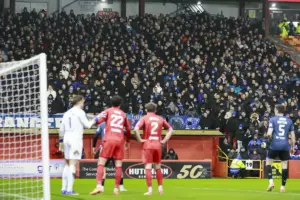

- John Swinney considers criminalising pitch invasions amid growing Scottish football disorder concerns.
- Ibrox damage dispute remains unresolved with Rangers seeking £1m, Celtic contesting liability.
- Calls grow for clearer governance as policing strain and planning inconsistencies continue.
First Minister John Swinney’s confirmation that the Scottish Government will consider making pitch invasions a criminal offence has reignited a wider debate about control, responsibility and consistency in Scottish football.
This is now a debate that stretches far beyond isolated incidents and into the structural governance of the game itself.
Speaking to Clyde 1, Swinney confirmed that legislative options are under active review.
This comes following a season in which pitch invasions, policing strain and post-match disorder have repeatedly exposed gaps in planning and enforcement across major fixtures.
“I will consider those proposals around making it a criminal offence to be part of a pitch invasion,” he said.
But the political intervention is only one layer of a broader issue that has been building across the campaign.
Beneath it sits a recurring tension between clubs, authorities and supporters.
All over where responsibility begins and ends when control breaks down.
Ibrox damage case remains unresolved
That tension is most visibly illustrated by the fallout from the Scottish Cup quarter-final at Ibrox in March.
Following which a pitch invasion from the Broomloan Road end resulted in significant damage to perimeter infrastructure, including LED advertising boards.
Repair costs have been estimated at around £1 million by Rangers.
Celtic however, have reportedly offered a figure far below that total.
The Hoops citing Scottish FA regulations which cap liability in such incidents.
The dispute remains unresolved.
For Rangers, the case has become emblematic of a wider concern.
The club were open on their reservations of housing a larger Celtic support for the Cup clash but were forced to house a full stand of Hoops fans due to an SFA intervention.
Subsequent incidents involving Celtic fans at Fir Park, where an elderly supporter was attacked.
And again on Saturday, this would suggest Rangers had a point despite claims of equal liability towards both sets of supporters following the match.
John Swinney blames planning inconsistencies
Swinney himself highlighted what he described as uneven standards in matchday preparation across Scotland’s major fixtures.
“I think there was a very clear contrast at the weekend,” he said.
“In Edinburgh, the City Council and Hearts had agreed a plan as to what would happen should Hearts have been successful and in Glasgow that wasn’t the case.”
He added that while discussions had taken place to manage crowd control and reduce risk.
They did not always translate into operational delivery.
“There were discussions that were taking place to try to create a more orderly environment,” he said.
“But they did not lead to the establishment of that.”
Shared responsibility, but growing political pressure
Swinney stressed that responsibility is distributed across government, football authorities, clubs and local councils.
However he acknowledged the need for more coordinated intervention.
“So, we’ve got a job of work to do,” he explained.
“Working with the football clubs and the SPFL and with the City Council to avoid this situation ever happening again.”
However, he also returned to the central issue that has defined the debate throughout the season.
“Fundamentally at the heart of this is the unacceptable behaviour of a minority of fans,” he added.
“That has got to be addressed.”
Police warnings and Celtic’s city centre disorder
The urgency of that assessment has been reinforced by the policing response to recent incidents in Glasgow city centre following the title-deciding fixture at Celtic Park.
Police Scotland confirmed that officers were injured during disorder in the Trongate area.
In incidents where missiles were thrown as large crowds gathered.
Assistant Chief Constable Mark Sutherland described the scenes as “unacceptable levels of violence” and said officers were left dealing with “significant disorder”.
He called for urgent engagement between clubs, councils and governing bodies to prevent repetition, warning that improved coordination is essential to reduce risk.
Glasgow City Council were equally direct, describing recent disorder as “an embarrassment” and highlighting the strain placed on emergency services, public infrastructure and local businesses.
Martin O’Neill defends celebrations as debate splits opinion
The interpretation of pitch invasions themselves remains contested, particularly following comments from former Celtic manager Martin O’Neill during a discussion with Jim White on TalkSport.
Pressed on whether supporters entering the pitch undermined the occasion, O’Neill pushed back firmly on the criticism.
“There is a suggestion that this shows a lack of class, that it’s tainted the image, I totally disagree with that,” he said.
Jim White challenged him directly, asking whether supporters should have entered the field of play at all.
“They shouldn’t have come on the pitch, Martin, should they?” he said.
O’Neill responded: “Well, start telling that to every single football club…”
More whataboutery.
White later referenced concerns raised by opposing figures, including claims of disorder and confrontation involving players.
“It seems that in certain quarters within the stadium, all discipline was lost,” he said.
O’Neill rejected that characterisation, insisting that the emotional context of the moment was being overlooked.
“What do you mean, a free for all?” he replied. “It was a home game, and we’d just won the league.”
The exchange underlined a widening divide in opinion.
Whether pitch invasions are a controllable safety breach or an inevitable expression of sporting emotion, and where the legal line should ultimately sit.
The structural issue beneath the arguments
Beyond individual incidents and post-match debate, the underlying issue remains unresolved.
Scottish football lacks a consistently enforced framework for managing high-risk fixtures where crowd mobilisation is predictable and large-scale.
That gap is now manifesting in three areas, policing pressure, financial disputes between clubs, and political consideration of criminal sanctions.
Swinney’s confirmation that pitch invasions will form part of a review of football banning orders signals that Holyrood is no longer content to rely solely on voluntary compliance or post-incident sanctions within the sport itself.
From flashpoints to systemic failure
What has changed over the course of the season is not the existence of disorder, but its frequency and predictability.
Pitch invasions and post-match incidents are no longer treated as isolated events but as recurring outcomes of structural weaknesses in planning and enforcement.
The unresolved Ibrox damage case has become a reference point in that wider debate over accountability, allocation risk and cost recovery.
It has become part of a broader question over whether the current system is capable of delivering consistent public safety outcomes.
And for football authorities, it raises a more uncomfortable question still.
Whether existing governance structures are equipped to manage modern supporter behaviour.
Read Rangers analysis
With the Scottish Government now openly considering criminalisation of pitch invasions, with disputes over damage and responsibility still ongoing between clubs.
It is clear that legislative intervention is on the horizon.
Whether that results in new law, stricter enforcement of existing powers, or a fundamental redesign of matchday planning remains unconfirmed.
But the season’s evidence base, from Ibrox to Glasgow City Centre, has ensured that the status quo is no longer defensible in political or sporting terms.
If Scottish football cannot demonstrate consistent control, credible deterrence and fair financial accountability, then Westminster-style criminalisation is no longer an abstract comparison.
It is the only option to control wilder and bolder antics from supporters.